Asamaka: Advancing Intelligent EV Battery Assembly Systems
Asamaka represents a forward-looking approach to industrial automation, focusing on the development of intelligent and digitally validated manufacturing solutions.
Through the use of simulation technologies, robotics, and automated material handling systems, Asamaka explores how modern production lines can be designed, tested, and optimized before physical deployment.
The increasing demand for electric vehicles requires manufacturing systems capable of high precision, repeatability, and scalability. EV battery modules are critical components that require careful handling, accurate placement, and efficient assembly processes. Traditional commissioning methods often require extensive physical testing, which can be costly and time-consuming.
To address these challenges, the Asamaka Digital Twin Demonstration showcases how a virtual production environment can be used to model, simulate, and validate an EV battery module assembly line. By combining robotic automation, conveyor transport, and Cartesian gantry systems within a simulated environment, the system enables engineers to test control strategies, motion sequences, and system coordination before real-world implementation.
This approach reflects modern Industry 4.0 practices where digital technologies enhance productivity, reduce commissioning risks, and support the development of smarter manufacturing systems.
Bringing EV Battery Module Manufacturing to Life in a Digital Assembly Line
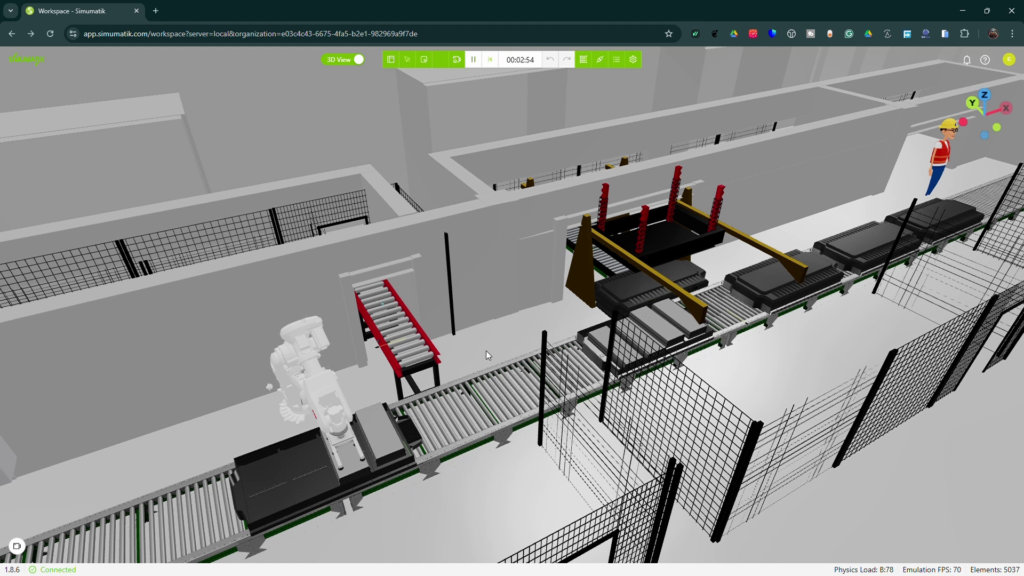
The Asamaka Digital Twin demonstration recreates an EV battery module assembly process within a fully simulated automation environment. The virtual production line models the flow of components, robotic manipulation tasks, and coordinated motion between multiple subsystems.
The system architecture integrates several key components that collectively form the automated assembly line:
- 6-Axis Industrial Robot: Responsible for picking battery modules from a feeder conveyor and placing them into predefined positions inside the battery tray.
- Roller Conveyor Transport System: Moves trays and modules between different stages of the assembly process.
- Cartesian 2-Axis Gantry (Y-Z Configuration): Handles the precise placement of the battery module cover.
- Virtual IO Mapping: Simulates PLC-style signal communication between system components.
- Python-Based RoboDK API Control: Provides programmable logic for coordinating robot motion and process execution.
Together, these subsystems create a cohesive automated workflow in which mechanical movement, sensor feedback, and control signals interact to simulate a realistic EV battery assembly process. The digital environment allows engineers to observe the full production cycle, validate motion sequences, and ensure reliable system behavior.
System Coordination and Integrated Automation Architecture
The successful operation of the digital assembly line depends on the seamless coordination between robotic systems, conveyors, sensors, and motion control mechanisms. Each subsystem communicates through a structured input/output signal architecture that replicates industrial PLC communication.
Virtual IO mapping is used to simulate the electrical signals that would normally connect machines within a physical production line. Digital inputs represent sensor signals such as product detection, position confirmation, and operation completion. Digital outputs control actuators including conveyor motors, robot commands, and gantry movement.
This signal-based communication enables deterministic coordination between the different components of the assembly line. For example, the conveyor system stops automatically when a battery tray reaches the robotic loading station, allowing the robot to execute its loading sequence. Once the robot completes the operation, the conveyor resumes movement to transfer the tray to the next stage.
Real-Time Process Monitoring and Operational Analysis
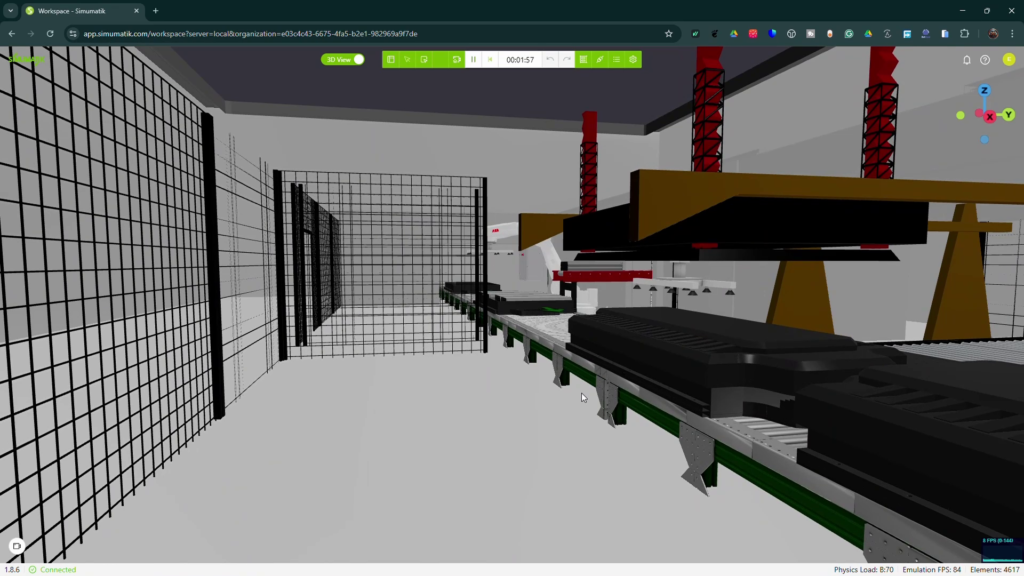
A key advantage of the digital twin approach is the ability to observe and analyze system behavior in real time. The Asamaka Digital Twin environment enables continuous monitoring of machine states, motion sequences, and control signals during operation.
Engineers can track conveyor status, robot motion progress, sensor activation, and gantry positioning as the assembly cycle executes. This real-time visibility allows early detection of potential issues such as motion conflicts, incorrect signal timing, or inefficient process sequences.
In addition to monitoring system behavior, the digital simulation environment provides valuable analytical capabilities. Collision detection algorithms help identify potential mechanical interference before deployment. Motion validation tools confirm that robotic trajectories are feasible and safe. Cycle time analysis allows engineers to evaluate system throughput and identify possible bottlenecks within the production flow.
By combining real-time monitoring with analytical tools, the digital twin becomes a powerful platform for optimizing automation strategies and improving manufacturing efficiency.